

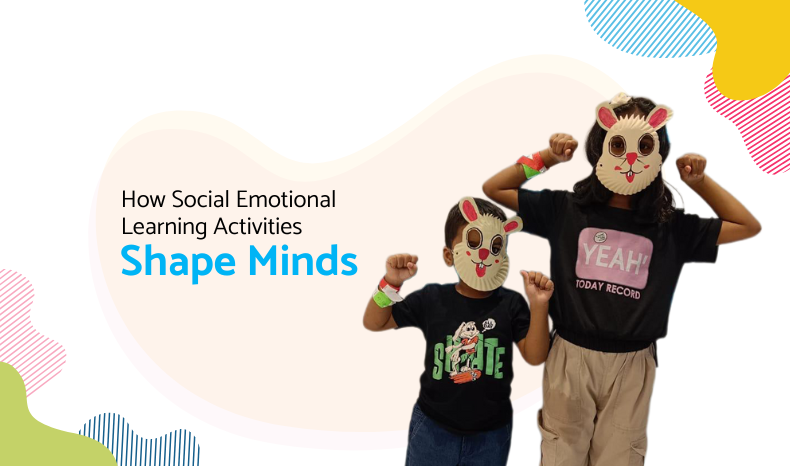
How Social Emotional Learning Activities Shape Minds
If you’ve ever paused to watch children lost in play, you know there’s something magical about it. The way they negotiate whose turn it is, the way they jump into imaginary worlds, the way emotions flicker across their faces — joy, frustration, excitement, curiosity. What feels like “just playtime” to us is, in reality, a quiet classroom where their earliest lessons in feelings and friendships take shape.
And in 2025, when childhood is more structured, busier, and a little more screen-heavy than we remember, these pockets of free, meaningful play matter more than ever. Play becomes the foundation of confidence, kindness, and emotional strength.
That’s exactly the heart behind Play ‘N' Learn — a thoughtfully designed play-based learning venue in Delhi NCR created by child-development experts from Active Edu Fun. For years, parents have trusted this centre as a place where children don’t just burn energy, they grow emotionally, socially, and cognitively through beautifully crafted experiences.
Among the most powerful tools they use are social emotional learning activities, woven naturally into play so kids learn while still being completely themselves.
What Really Happens When Kids Play?
Play is a child’s language. Whether they’re building a block tower, squeezing soft sand, running through an obstacle course, or acting out a pretend doctor visit, children are:
-
Making sense of their emotions
-
Testing boundaries safely
-
Practising communication
-
Learning how to work with others
-
Exploring problem-solving
-
Building independence
During play, children get to experience real feelings — disappointment, joy, confusion, pride, jealousy, and comfort — all within a safe space. They don’t need formal lessons; the learning happens naturally.
This is why well-designed activities for social development are so essential in early childhood settings. Kids absorb skills simply by doing, trying, failing, laughing, and trying again.
The Emotional Benefits of Play
Young children often feel everything in BIG waves, yet they don't always know how to express or understand what they’re experiencing. Play offers the perfect space for emotional clarity.
1. Building Resilience
Watch a toddler climb a soft ladder, slip, and decide to try again. That tiny moment? Its resilience growing. They learn persistence without even realizing it.
2. Understanding Empathy
Pretend play — superheroes, families, doctors, chefs — helps children imagine someone else’s world. They start recognising different emotions and thinking, “How does my friend feel?”
3. Reducing Stress
Movement play — sliding, running, bouncing — helps lower cortisol. Sensory activities calm overstimulated minds. A simple hour of play can do wonders for emotional balance.
At Play ‘N' Learn, these moments are intentionally supported through gentle social emotional learning activities, so emotional exploration feels natural and safe.
The Social Benefits of Play
While emotional skills shape how children feel, social skills shape how they connect with others. Play turns friendship-building into an effortless adventure.
1. Communication Skills
Games that require turn-taking, role-playing, or collaborative problem-solving naturally strengthen speaking and listening skills. Even shy children begin to find their voice.
2. Cooperation & Teamwork
Building a fort together, completing a group challenge, or even deciding rules of a pretend game teaches cooperation without pressure.
3. Making Real Friends
When children meet regularly in play settings, they learn to trust, include others, apologise, share, and show kindness. These early friendships teach some of the deepest social lessons.
This is the true power of social development activities — they shape how children connect with the world.
Creative Play Helps Children Express Themselves
Sometimes kids need crayons, movement, or pretend worlds to express what’s inside.
Art
Through drawing or painting, children express emotions they cannot yet verbalise. Lines, colours, and patterns become emotional reflections.
Music
Rhythmic play, singing, and instrument activities help children regulate their moods and channel energy positively.
Role-Play
Acting out real-life situations helps children process experiences — a hospital visit, a birthday party, a new sibling. It becomes a safe outlet for emotions and imagination.
These creative outlets are thoughtfully embedded within Play ‘N' Learn’s learning framework so children always have a way to express their inner world.
Why Children Need Both Free Play and Guided Play
A perfect play environment has a mix of both:
Free Play
Children choose what they want to do, for how long, and in their own style. This strengthens imagination, self-confidence, and independent decision-making.
Guided Play
Fun Buddies gently support children by modelling sharing, introducing social skills, guiding conflict resolution, or encouraging emotional vocabulary — without taking over their play.
This balance ensures children receive structure without losing the freedom that makes play meaningful. It’s a key principle behind Play ‘N' Learn’s activities for social development.
SEL Activities That Bring Learning to Life at Play ‘N' Learn
Every day at Play ‘N' Learn, trained fun buddies use simple but powerful social emotional learning activities to help children grow into emotionally strong and socially aware individuals.
Here are a few favourites:
1. Role Play Town – Building Empathy & Social Confidence
In our imaginative mini-city, kids become chefs, doctors, firefighters, shopkeepers and more. As they step into different characters, they learn to understand perspectives, collaborate with peers, solve problems together, and communicate confidently.
SEL Impact: Encourages empathy, cooperation, storytelling, and self-expression.
2. Sally’s WaterLab – Teamwork Through Playful Exploration
Water play brings kids together effortlessly. At WaterLab, children share tools, work on small experiments side by side, and help each other discover new reactions and textures.
SEL Impact: Strengthens collaboration, patience, sharing, and turn-taking.
3. Billy’s Organic Seed Pit – Calm, Mindful Play for Emotional Regulation
This soothing sensory space invites kids to bury, scoop, pour and explore organic seed-like material. It’s a grounding experience that naturally reduces anxiety and promotes calm.
SEL Impact: Helps children self-regulate, unwind, and feel emotionally centered.
4. Carly Coder’s Toddler Zone – Safe Social Beginnings for Little Ones
Designed especially for young explorers, this zone gives toddlers a safe environment to interact with others, build trust, and practice early social behaviours through parallel and shared play.
SEL Impact: Builds confidence, emotional security, and first friendships.
5. Robin Rockstar’s Jump Zone – Joyful Expression & Confidence Boosting
The disco trampoline space allows kids to express themselves freely through movement and rhythm. Jumping together encourages shared joy and healthy emotional release.
SEL Impact: Supports confidence, emotional expression, and positive social bonding.
Together, these play experiences make SEL a natural part of every visit. At Play ‘N' Learn, children aren’t just playing—they’re learning how to understand feelings, build friendships, resolve conflicts, and express themselves with confidence.
The Long-Term Impact of Early Social-Emotional Play
Years of research and experience show that early SEL builds lasting strengths:
-
Better emotional regulation
-
Stronger friendships
-
Lower stress and anxiety
-
Higher empathy
-
More confidence in group settings
-
Improved academic readiness
-
Healthier mental well-being
Children who participate regularly in social emotional learning activities tend to handle challenges better, adapt more easily, and communicate more clearly as they grow.
Every shared toy, every group laugh, every tiny disagreement resolved with a hug — it’s all part of shaping a child into a kind, confident, emotionally aware human being.
At Play ‘N’ Learn, these moments are not left to chance. They’re thoughtfully nurtured by fun buddies, supported through purpose-driven play environments, and guided by research-backed developmental practices.
If you’re looking to build your child’s emotional and social foundation through meaningful, joyful play, this is the place to begin.


